
## Short Answer
**Max. length of workpiece on a lathe machine** is the maximum overall length of a workpiece that the machine is designed to accommodate under its specified setup. It tells buyers whether a shaft, roller, tube, or other long part can physically fit on the lathe.
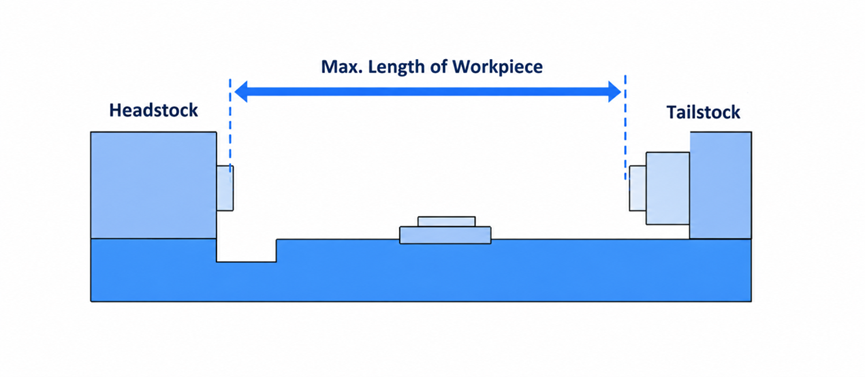
However, it is **not always the same as max. turning length or distance between centers**. A 1500 mm workpiece may fit on a lathe, but the entire 1500 mm may not be machinable because the chuck, tailstock, tool post, and clamping position use part of the available space.
For this reason, when choosing a lathe for a long shaft, do not check workpiece length alone. Always compare **max. workpiece length, max. turning length, distance between centers, workholding method, workpiece diameter, weight, and required machining area**.
---
# Why Does Max. Length of Workpiece Matter?
Workpiece length is one of the first specifications to check when selecting a lathe for:
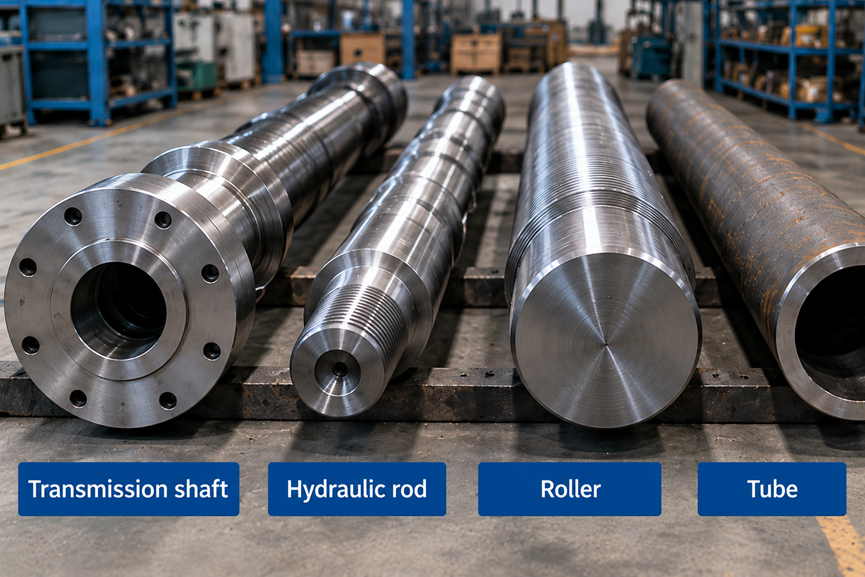
- Transmission shafts
- Hydraulic rods
- Motor shafts
- Rollers
- Axles
- Tubes
- Long sleeves
- Marine shafts
A machine with sufficient swing over bed but insufficient length still cannot accommodate the required part.
## Typical Long Workpieces
| Industry | Typical Workpiece | Material | Example Size | Main Process |
|---|---|---|---:|---|
| General machinery | Stepped shaft | 40Cr | Ø120 × 1000 mm | OD turning + threading |
| Hydraulic equipment | Piston rod | 42CrMo | Ø90 × 1500 mm | Finish turning + grooving |
| Transmission | Drive shaft | 40Cr | Ø160 × 2000 mm | Step turning + threading |
| Steel industry | Roller | 42CrMo | Ø500 × 2500 mm | Rough + finish turning |
| Heavy machinery | Main shaft | 42CrMo | Ø650 × 3000 mm | Heavy OD turning |
| Pipeline equipment | Tube | Carbon steel | Ø168 × 3000 mm | Facing + threading |
**“What size lathe do I need for a 2-meter-long shaft?”**
the answer cannot be based on the 2000 mm length alone.
You also need the shaft diameter, weight, clamping method, machining area, material, tailstock requirement and support method.
---
# Why It Matters for Long Shaft Machining
As workpiece length increases, rigidity becomes increasingly important.
For example, compare these two 40Cr shafts:
| Workpiece | Diameter | Length | L/D Ratio | Main Concern |
|---|---:|---:|---:|---|
| Shaft A | Ø200 mm | 1000 mm | 5:1 | Normal turning |
| Shaft B | Ø60 mm | 1500 mm | 25:1 | Deflection and vibration |
Both may fit on the same lathe by length, but **Shaft B is much more difficult to machine**.
A long, slender shaft may require:
1. Tailstock support
2. Steady rest
3. Follow rest
4. Reduced cutting force
5. Appropriate tool geometry
6. Multiple machining passes
Therefore:
**Maximum workpiece length tells you whether the part fits. It does not guarantee that the part can be machined accurately without additional support.**
---
# Difference: Max. Workpiece Length vs Max. Turning Length vs Distance Between Centers
These three specifications are related, but they should not be treated as identical.
| Parameter | Meaning | What Buyers Should Check |
|---|---|---|
| **Max. Length of Workpiece** | Maximum overall workpiece length the machine can accommodate | Can my part physically fit? |
| **Max. Turning Length** | Maximum length that can actually be turned under the specified setup | Can the required surface be fully machined? |
| **Distance Between Centers** | Distance between headstock center and tailstock center | Can my shaft be supported between centers? |
## Max. Length of Workpiece
This describes the maximum overall workpiece length supported by the machine configuration.
For example:
**Max. length of workpiece: 1500 mm**
does not automatically mean that 1500 mm of the OD can be turned.
---
## Max. Turning Length
Max. turning length describes the usable longitudinal machining range.
Part of the machine space may be occupied by:
- Chuck
- Workpiece clamping section
- Tailstock
- Tool post
- Tool holder
- Center
- Fixture
Therefore:
**Max. turning length can be shorter than max. workpiece length.**
---
## Distance Between Centers
Distance between centers is particularly important for shaft machining.
The workpiece is supported between the spindle/headstock side and the tailstock center.
For example:
**Distance between centers = 2000 mm**
means the nominal center-to-center space is 2000 mm.
But if the shaft is held in a chuck and supported by the tailstock rather than mounted directly between centers, the usable workpiece length may change.
---
# Example: Choosing a Lathe for a 1500 mm Shaft
Consider a real machining requirement:
| Item | Requirement |
|---|---|
| Workpiece | Hydraulic transmission shaft |
| Material | 42CrMo |
| Maximum OD | Ø180 mm |
| Overall length | 1500 mm |
| Machining length | 1350 mm |
| Workpiece weight | Approx. 250 kg |
| Process | Facing + OD turning + grooving + threading |
| Tolerance | ±0.03 mm |
| Surface roughness | Ra 1.6 |
| Quantity | 15 pcs/month |
The customer asks:
**“Can I use a lathe with 1500 mm max. workpiece length for a 1500 mm shaft?”**
The safest answer is:
**Do not select it based only on the nominal 1500 mm specification.**
The chuck and tailstock setup may reduce usable space.
A machine with a longer available capacity — for example, a **2000 mm configuration** — may provide more practical setup and tool-access space.
---
# Example: 2500 mm Industrial Roller
Now consider a larger workpiece:
| Item | Requirement |
|---|---|
| Workpiece | Industrial roller |
| Material | 42CrMo |
| Maximum OD | Ø500 mm |
| Overall length | 2500 mm |
| Weight | 1800 kg |
| Process | Rough turning + finish turning |
| Tolerance | ±0.05 mm |
| Surface finish | Ra 3.2 |
For this application, the buyer should not simply search:
**“2500 mm CNC lathe.”**
The important specifications are:
| Parameter | Why It Matters |
|---|---|
| Swing over bed | Ø500 mm must rotate safely |
| Swing over carriage | Carriage must clear required diameter |
| Max. workpiece length | Must accommodate 2500 mm part |
| Max. turning length | Must cover required machining area |
| Max. workpiece weight | Machine must safely support 1800 kg |
| Guideway width | Important for rigidity |
| Tailstock | Supports long workpiece |
| Steady rest | Helps support long/heavy roller |
| Main motor power | Important for heavy rough turning |
For a large roller like this, a **heavy-duty flat bed CNC lathe** is generally more suitable than a compact CNC lathe.
---
# Example: Small CNC Lathe vs Heavy-Duty CNC Lathe
Machine size should match the actual workpiece.
## CK0640 — Small CNC Lathe
A compact CNC lathe such as CK0640 is designed for much smaller components.
| Parameter | CK0640 |
|---|---:|
| Swing over bed | Ø300 mm |
| Swing over carriage | Ø110 mm |
| Max. length of workpiece | 180 mm |
| Spindle bore | Ø40 mm |
| Spindle speed | 3000 rpm |
Typical workpiece:
**45# steel shaft, Ø30 × 150 mm**
This is suitable for compact components and short shafts rather than long industrial shafts.
---
## Large Flat Bed CNC Lathe
For a workpiece such as:
**42CrMo roller, Ø500 × 2500 mm**
the selection priority changes to:
**Length + Weight + Swing + Rigidity + Support**
This is why larger flat-bed CNC lathes are commonly used for long shafts, rollers and heavy cylindrical components.
---
# Common Mistakes
## 1. Assuming Max. Workpiece Length = Max. Turning Length
This is the most common mistake.
A machine may physically accommodate the workpiece without being able to turn its entire length in one setup.
Always ask the manufacturer for the **actual turning length under your required chuck and tailstock configuration**.
---
## 2. Selecting a 1500 mm Machine for an Exactly 1500 mm Workpiece
Nominal capacity does not always provide enough practical setup space.
For example:
**Workpiece length: 1500 mm**
Selecting:
**Machine capacity: exactly 1500 mm**
may leave insufficient room for clamping, centering or tool access.
---
## 3. Ignoring Workpiece Diameter
Length is only one dimension.
A machine that accommodates a 2000 mm long Ø100 mm shaft may not accommodate a:
**Ø700 × 2000 mm roller**
because swing and load requirements are completely different.
---
## 4. Ignoring Workpiece Weight
Long steel parts can become extremely heavy.
Always provide:
**Diameter + Length + Material + Weight**
instead of only saying:
**“I need a lathe for a 3-meter shaft.”**
---
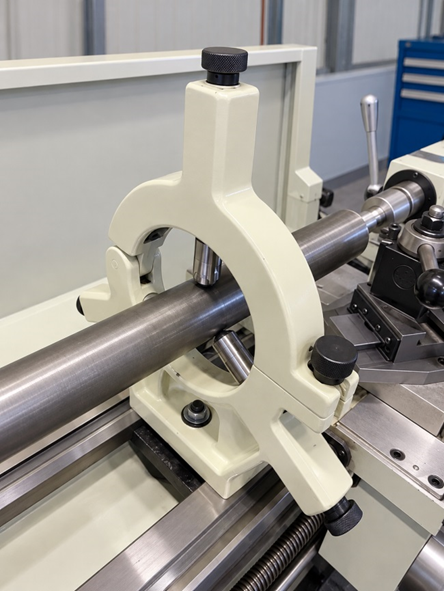
## 5. Ignoring Long-Shaft Support
A long, slender shaft can bend or vibrate during machining.
Check whether the machine requires:
- Tailstock
- Steady rest
- Follow rest
- Live center
---
## 6. Confusing Spindle Bore with Workpiece Length
Spindle bore determines whether a bar or pipe can pass through the spindle.
It does not determine the maximum length of a shaft mounted between the chuck and tailstock.
### What spindle bore size do I need for a 3-inch pipe?
A standard **NPS 3 pipe has an outside diameter of approximately Ø88.9 mm**.
If the pipe needs to pass through the spindle, the spindle bore must be **larger than Ø88.9 mm**, with additional clearance for convenient loading.
For long pipe machining, also check:
**spindle bore + chuck configuration + pipe length + support system**
---
# Buyer Checklist
Before asking a machine tool manufacturer:
**“What lathe do I need for my shaft?”**
prepare the following information.
| Information | Example |
|---|---|
| Workpiece type | Stepped shaft |
| Material | 42CrMo |
| Maximum OD | Ø350 mm |
| Minimum OD | Ø180 mm |
| Overall length | 2000 mm |
| Required turning length | 1750 mm |
| Workpiece weight | 850 kg |
| Process | Rough + finish + groove + thread |
| Thread | M120 × 3 |
| Dimensional tolerance | ±0.03 mm |
| Surface finish | Ra 1.6 |
| Production | 20 pcs/month |
| Drawing | Recommended |
## Before Ordering, Confirm These Parameters
1. Max. length of workpiece
2. Max. turning length
3. Distance between centers
4. Swing over bed
5. Swing over carriage
6. Max. workpiece weight
7. Chuck size
8. Spindle bore
9. Tailstock configuration
10. Steady rest / follow rest
11. Actual usable machining length with the required fixture
---
# FAQ
## What is max. length of workpiece on a lathe?
It is the maximum overall length of a workpiece that the lathe is designed to accommodate under its specified setup.
It should not automatically be interpreted as the maximum length that can be turned.
---
## Is max. workpiece length the same as max. turning length?
**No.**
Max. workpiece length tells you whether the part can fit on the machine.
Max. turning length tells you how much longitudinal length can actually be machined under the specified configuration.
---
## What is the difference between distance between centers and max. workpiece length?
Distance between centers measures the available distance from the headstock center to the tailstock center.
Max. workpiece length refers to the overall length capacity under a specified machine setup.
They may be similar on some machines but should not automatically be treated as identical specifications.
---
## What size lathe do I need for a 1500 mm long shaft?
Do not choose the machine from length alone.
Provide:
**Diameter + 1500 mm length + material + weight + machining length + clamping method + tolerance**
If the workpiece itself is exactly 1500 mm long, a longer machine configuration may provide more practical room for chucking, tailstock support and tool access.
---
## What CNC lathe do I need for a 2-meter-long steel shaft?
For a 2000 mm shaft, check at least:
| Parameter | Requirement |
|---|---|
| Max. workpiece length | Must accommodate the complete shaft |
| Turning length | Must cover the required cutting area |
| Swing over bed | Must exceed required diameter clearance |
| Workpiece weight | Must be within machine capacity |
| Tailstock | Normally required |
| Steady rest | May be required for long/slender shafts |
A drawing is the safest way to confirm the machine configuration.
---
## Can a 3000 mm lathe machine a 3000 mm shaft?
Not necessarily.
“3000 mm” may refer to distance between centers, maximum workpiece length or another nominal machine specification.
Ask the manufacturer to confirm the **actual usable turning length with your chuck, tailstock and workpiece setup**.
---
## How do I choose a lathe for a long and thin shaft?
Pay attention to the **length-to-diameter ratio**, not just total length.
A Ø60 × 1500 mm shaft is much more prone to deflection and vibration than a Ø200 × 1500 mm shaft.
Tailstock, steady rest, follow rest, cutting parameters and workpiece rigidity should all be considered.
---
## What information should I send to a lathe manufacturer?
The most useful information is a **workpiece drawing** together with material, maximum diameter, overall length, machining length, weight, tolerance, surface roughness, machining process and monthly production quantity.
This allows the manufacturer to check the machine's actual machining capacity instead of recommending a model from only one parameter.
Message
If you have any suggestions or question for us.Please contact us.


